Monday, July 4, 2011

Pay It Forward


In some ways, writing a blog reminds me of my early days in radio, hosting a show. You take it as something of a leap of faith that anyone is actually paying attention. So, when I do receive feedback, I'm legitimately touched that what I've written or said, impacted another person enough that they are sufficiently motivated to respond.

Last month, I received two very different pieces of feedback that were too coincidentally connected, to ignore.

First, was a comment from a complete stranger about my "How I Became A Customer For Life" blog, where I told the story of growing up in Montreal and becoming a St. Louis Cardinals fan. The email ended with a question:

"So, have you managed to follow your own advice when it comes to customer service?"

Well, not always, but I certainly aspire to exceed expectations.

Let me tell you about an example of extraordinary customer service, that I was recently reminded of:

It was a nasty Vancouver evening in the fall of 2004. Not the kind of light rain that's marginally annoying (and I can assure you that no one who's actually from the West Coast refers to it as liquid sunshine) , but a pounding, driving downpour that keeps even the die-hards indoors.

A group of four of us were having dinner at a restaurant, before attending a Sarah MacLachlan concert at GM Place. Dinner was running a little late, so I asked our server if he could call us a cab, as our cheque arrived, anticipating that taxis would be in high demand.

That was an understatement. After paying the bill, we waited 20 minutes for a cab. Our server made two more calls to check the status of our ride and was given a rather non-specific commitment.

I was a little anxious to get to the venue, as I had made a commitment to see the opening act. The Server, whom I 'd never met before that evening, was aware of this, and after his final attempt to call and secure us a cab, he borrowed a car from the manager and insisted on driving us to the concert venue. We gratefully accepted his unprompted offer.

During the brief drive to the arena, we chatted about favourite concerts, and our server-turned driver, revealed that he was "the world's biggest Tragically Hip fan," and had seen the band perform, dozens of times. As he pulled up to our gate entrance, I handed him a sum of cash that I felt was commensurate with his extraordinary service. He smiled and refused. Wow!

Think about that for a second. It's certainly no secret that those make a living as servers in the restaurant business, subsist on gratuities. In fact, this is the most fundamental model of customer service: Quality of service = % of Tip!

But he had refused my effort to compensate him for his time and effort. He seemed genuinely happy to have been able to help us out, and to get us to the venue in time to see the opening performer. Now that's extraordinary customer service!

The next day, as I retold the story to more than a few people (that's what you do when you experience superb customer service), I realized that I could do something special for this guy. So I called in a favour.

Several weeks later, it arrived. A Tragically Hip poster, autographed by every member of the band, with one added name hand-written below the signatures with the word "Thanks!" That added name belonged to the "World's Biggest Tragically Hip Fan," our server, who had driven us to the concert . I had this one-of-a-kind piece framed, found out when our server was working next, and delivered it to the restaurant. He was surprised and seemed genuinely ecstatic. I admit to feeling pretty good myself!

I'd actually forgotten about this event of nearly 8 years ago. But, as I mentioned off the top, I received two different pieces of connected feedback this week. Here's the second.

I was Facebooked by an acquaintance from my days in the broadcast industry. She told me that during a recent dinner conversation with friends in Edmonton, the waiter overheard them talking about the radio business and asked if they knew 'Eric Samuels.' The waiter went on to tell his version of the story of that night in Vancouver, ending with the autographed Tragically Hip poster. Her Facebook note ended with the following (which I offer with her kind permission):

"I'm certainly we're not the first to hear that story. You really made him feel special."

Now I admit that I don't do this kind of thing very often. Circumstances demanded that I do something, and opportunity allowed me to reciprocate in the manner in which I did. And here we are, 8 years later, and it's still being talked about.

Extraordinary effort makes for great story-telling, and great stories are told and retold, over and over again. Plus, it's not bad having the reputation of being an excellent tipper. Whenever I dine out, I seem to get excellent service!

Friday, June 10, 2011

Hakuna Matata II; The 'Other' Cycle Of Life

In the spring of 2001, I moved into a wonderful, tree-lined neighbourhood in Toronto. Given its central location, it was a remarkably quiet street - at least until that July night when the serene silence was shattered by a series of startling noises emanating from the back of the house.

Awakened from a deep slumber, my brain in a state of foggy semi-consciousness, instinct kicked in; I experienced a deep sense of territorial imperative - I must protect the cave!

So, I armed myself with the nearest weapon at hand, a mid-wedge from my golf bag (club selection is key, both on and off the course), threw on a robe & slippers and gallantly (to be honest, it was closer to gingerly) made my way out the back patio doors.

Out of the corner of my eye, I caught an immediate glimpse of the brazen masked perpetrators. Simultaneously, what appeared to have been the gang leader, stared right back at me with a fixed gaze that was both fearless and defiant. At that very moment, we were both confronted by that most primordial of decisions; fight or flight.

There were 3 of them for certain; although, I will admit to having retold the story so as to suggest there were at least 6 or 7. Regardless of actual numbers, the inertia was broken by their leader, who suddenly backed off and strolled down the driveway, without breaking eye contact. The others quickly and silently followed suit. They chose to live and fight another day!

I don’t know what it was that caused them to leave that night, but I’ve thought about it often. It might have been my sudden, unexpected appearance; draped in a red lumberjack patterned robe, rug-beaten slippers, recently re-gripped wedge at the ready. Whatever their motivation, I had successfully protected my turf without a single drop of bloodshed.

What was shed, were my garbage can’s contents, strewn over the driveway like a grand trash buffet. This despite my having firmly fastened the locking handles on the lid. But as you probably know, raccoons are smart that way. The next week, I added a complex series of bungee cords to the works. They were now impenetrable as Fort Knox! Remarkably, the masked marauders managed to overcome my extended security measures. I guess our garbage was just that good. Or perhaps it was the challenge alone, that enticed this relentless gang.

Then it happened. That same week, I noticed a series of posted signs on the wooden telephone poles on my street: “Racoon Problem? Call XXX-XXXX for humane removal”

That’s the thing about advertising. You don’t notice all of the refrigerator ads until your Whirpool breaks down and you find yourself in the market for a new fridge. Then, it seems like coincidentally perfect timing that so many stores seem to be having a sale on refrigerators, just when you need one!

But coming from a marketing background, I knew better, and must admit that another thought soon crept into my mind. Could the sudden and timely appearance of the solution to my problem be more than simply cognitive reframing?

Specifically, what if the racoons that suddenly appeared, wreaking havoc as if in a Disney episode, were actually domesticated by the same people who posted the signs offering to remove the pesky masked mammals (for a fee, of course); only to then gather up their trained critters and move on to the next neighbourhood mark! Seem a tad too conspiratorial? Well, you may want to sideline your scepticism for just a second, ‘cause here’s the thing.....

That same week I learned an interesting tidbit from a friend in law enforcement. In Ontario, as in several other Provinces and States, the use of radar detectors in vehicles, is illegal. Get caught with one and you’ll not only receive a hefty fine, but the device will be confiscated.

Which begs the question, how could police officers know you’re using a radar detector in the first place? I’ve heard lots of theories, including my favourite – if they see your brake lights go on when they engage their speed gun, they know you’re packing hardware.

As is usually the case, the actual method is much simpler. Police cruisers were equipped with radar detector-detectors. These devices were designed with the specific intent of identifying radar detectors in moving vehicles. Now we get to the interesting part of the story.

One of the largest radar detector manufacturers in the world is located in Ontario – a province in which the use of the devices is illegal. Ironic, huh? Well, there’s more. The same company also produced radar detector-detectors for the police, specifically designed to detect their own brand of detectors! Now if this is beginning to give you a headache, you might want to take a Tylenol, because there’s more.

The radar detector companies continued a cycle of releasing radar detectors billed as being immune to current radar detector-detecting technology. They would then develop the next generation of detector-detectors to sell to law enforcement, so as to bust the next generation of their own detector-detector proof detectors! Technically, we have now been down the road of counter-technology to the extent that the current generation is cited as a radar-detector-detector-detector-detector-detectors. And I’m not kidding!

So, we have an organization creating both a problem and the proprietary solution. How’s that for a business model? Part of me wants to stand up and applaud, although I must admit that another part of me would like to visit the lushly manicured lawns of their head office, with a family of raccoons.

Saturday, May 28, 2011

Managing the Micro-Manager


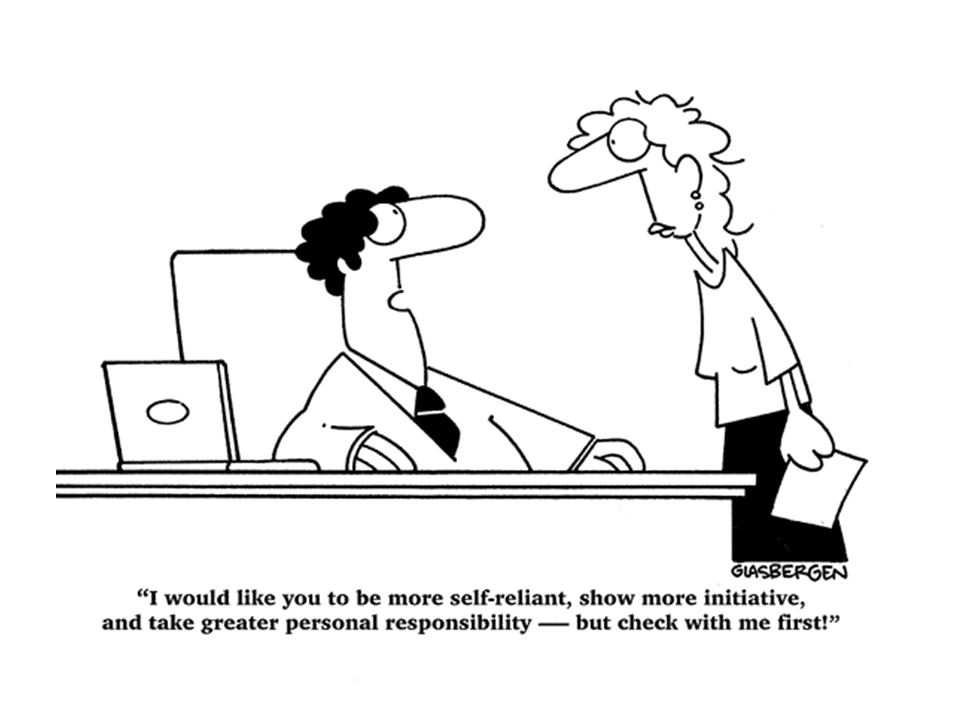
Micro-managing. We've all experienced it. The boss who pays painstaking attention to minutia, resulting in a stifling environment where employees feel their every action is being closely monitored. With few exceptions, a micro-manager's need to control the workplace is a fear-based response to their own insecurity about allowing other people the latitude to make decisions.

We're back to the smartest person in the room syndrome.

Problem is, micro-managed businesses are far more likely to stall, as there is no incentive for initiative; the cornerstone of growth within a healthy organization. On the contrary, micro-managers are risk-averse, reluctant to consider the possibility that anyone else might have a better idea on how to get things done.

It's important to understand what motivates the micro-manager, many of whom are business owners or CEOs. They are motivated by their own fear of failure.

Being The Boss means making major decisions that have a direct impact on the bottom-line. Oftentimes, a manager becomes overwhelmed by the magnitude of top-level decisions, choosing to backburner his actions (a cute euphemism for procrastination). Instead, the boss feels the need to focus his attention on things that will make him feel like he's functioning effectively as a manager. So, by streamlining the supply closet's stapler inventory, the micro-manager feels like he's accomplished something, which helps restore his confidence and the sense that he's in charge.

It's important to emphasize that his positive feeling of accomplishment is the same neurological response (the release of feel-good dopamine into the bloodstream) as his having achieved the more significant, top-level business task. However, the dopamine released is far less significant, resulting in a much shorter-term buzz. The solution? There's more where that came from! As a result, micro-managing, like any feel-good drug-use, usually escalates, making an organization more and more suffocating for the employees.

So, how do you break the cycle of micro-management? It's not easy, particularly if it's part of the corporate culture. It's like that old joke "how many Psychiatrists does it take to change a light bulb? One, but the light bulb has to want to change!"

Unless the micro-manager is given substantial incentive to change, he'll continue to do what feels right. So, what kind of incentives are effective?

· Firm feedback from his manager, who is aware of the problem.

· Indirect employee feedback (staff quit and provide critical feedback upon departure).

· Failing business (this requires a manager with both the insight and fortitude to look at his own performance in direct relation to the results)

· Direct employee feedback (staff who have both the nerve and tact to approach the boss).

The final point is rare, risky, but achievable. Approaching a micro-manager in a non-confrontational manner is an art in itself. Effective methods include:

  • Building the confidence of the manager by keeping him informed of the progress of projects (particularly those that he has shown an interest in).
  • Asking for feedback and direction (even if you have a good idea of what needs to be done), then provide measurable results in a timely fashion.
  • Demonstrating how delegating to you is in his best interest, by voluntarily taking on projects that you know are in your wheelhouse.

It's all about managing upwards.

That said, managing the micro-manager is not easy. As a result, micro-managers lose good employees all the time. So if you find yourself in a position where a micro-manager has eroded your enthusiasm for the job, and you've exhausted all available efforts, it might be time to look elsewhere.

Suggested Reading: MESSAGES: THE COMMUNICATION SKILLS BOOK (Matthew McKay, Martha Davis, Patrick Fanning)

Thursday, May 19, 2011

How I Became A Customer For Life


Like a lot of kids, I developed a love for the game of baseball when I was 10 or 11 years old. In my case, this new interest was undoubtedly sparked by the arrival of the Montreal Expos, who made their major league debut at Jarry Park, in the North end of the city, not far from where I lived.

In retrospect, Jarry Park was not a great ballpark. In fact, it was not the city's first nor second choice for a stadium (The city of Montreal's incompetence regarding stadiums is an entirely different subject for another day!). That said, to an 11 year old kid, Jarry Park was heaven - I used to pay a buck for a seat in the bleachers. It was 2-weeks allowance, but worth every penny!

Now I didn't get to go to a lot of games, but when I did, it was a pretty big deal, and it didn't matter who The Expos were playing. I'd always get there early (really early), to watch warm-ups and batting practice. I never failed to wear my Expos cap, and always brought my baseball glove, dreaming that one day I would snag a foul ball and have the greatest souvenir in the world to show my buddies at school!

The one redeeming quality of Jarry Park, was its intimacy. The park had a capacity of just over 28,000, which is quite small by today's standards (the average MLB park has over 44,000 seats) . But it was never designed for Major League Baseball, and very rarely full. So, I quickly learned that I could buy my $1 ticket and simply walk over to the premium box seats to stand behind the dugout and watch batting practice. Surprisingly often, I discovered that I could stay in an unoccupied box seat for the entire game!

I loved the pre-game warm-ups. As an aspiring ball player, watching the guys toss a ball back and forth, snag pop flies and then hit a few in the cage, was mesmerizing! Anytime one of the players came near the dugout, I tried to overcome my shyness and call them out by name, asking for an autograph on my glove or cap. Occasionally, I even found the nerve to ask for a baseball, if one of the players happened to be bringing a ball back to the dugout!

To me, the players were larger than life.....John Boccabella, Manny Mota, Bill Stoneman, and the guy who actually made it cool to have red hair (and I had a head full of it) - Rusty Staub!

That entire first season, I went to at least a dozen games. Always got there early to watch warm-ups from behind the Expos dugout and always stayed until the final out. Always had my Expos cap & glove, and always asked for autographs from the players during warm-up. But during all those games, not a single player ever stopped to sign my glove or hat. Not one. I figured it must have been me. I started to accept that I just didn't matter to these guys, whom I had come to idolize. I asked less and less.

Then, on a perfect summer day in 1969, I had an experience that changed everything. The St. Louis Cardinals came to town. Although the 1969 Cardinals weren't contenders, they had won the World Series twice in the past 5 years, and had several notable players on their roster - including pitcher Bob Gibson, who still holds the (modern day) major league record for earned run average; Lou Brock, one of the greatest base stealers of all time; and Joe Torre, a great player who would go onto become one of the greatest coaches in the game.

I couldn't tell you exactly what it was that made me walk over to the opposition's dugout that day in June, but there was definitely something about the Redbirds that intrigued me. More importantly, there seemed to be less and less reason to hang out by the Expos dugout. That afternoon, with little effort on my part, Lou Brock signed my cap, Joe Torre autographed my glove, and on his way back from the bullpen, Bob Gibson looked me straight in the eye and tossed a ball right into my mitt!

The Cards won 8-1 that day, but even before the first run was scored, I had become a fan for life. I bought a Cardinals cap as soon as I saved up enough allowance, and wore it faithfully, despite being harassed by kids at school, who couldn't possibly understand why I didn't root for the home town team!

I've been a St. Louis Cardinals fan for more than 40 years now. I've followed the team through some great times and many struggles. But it doesn't matter, Bob Gibson looked me straight in the eye and tossed me a baseball. That's how I became a customer for life!

Saturday, May 14, 2011

I'm Feeling Pretty Good About This Blog

There seems to be an epidemic of unusually high self-esteem.

Now don't get me wrong. When it comes to the taking a stand on the half-full or half-empty analogy, I like to think of the glass as simply being larger than required. I believe that makes me an optimistic leaning pragmatist.
But you can't help but notice that in an increasingly complex world with more than its share of challenges, we seem to feel pretty darn good about ourselves!

Efforts to help build our self-esteem are everywhere. While self-help books, endless classes and courses, framed posters with clever sayings and soul-stirring images, are nothing new, now, more than ever, they seem to propose the solution for whatever ails. Marriage in trouble? Must be your self-esteem. Can't find a job? Got to be your self-image. Can't sink the putt or put away the competition in game 7? Look no further than how you see yourself.
Feeling pretty good about who we are is important, particularly when we deserve it, by doing the right thing whenever possible. Similarly, feeling lousy about ourselves when we do something we know is wrong (and let's face it, we all fail to live up to our own best standards, at times) , is also proper and correct. But the suggestion of many of the self-esteem snake-oil salesmen, is that a robust sense of self will help you to burst through all the uncertainties of life and allow you to carry yourself with nothing but confidence and certainty. Herein lies the problem.

Doubt and caution serve a specific purpose in the way we go about making decisions. And if the uncertain thoughts themselves weren't enough to cause pause and reflection, the accompanying visceral response of our body to stress, is the equivalent of our car's GPS announcing, in that warm but determined voice...."at the first available opportunity, turn around."

We're not supposed to always have the answer. We can't possibly know it all. There's actually no such thing as 'the smartest guy in the room' (and even if there was, the moment we think we are that guy - we're not).

You can certainly understand why we're drawn to this notion of infallibly feeling good about ourselves. The appeal is self-evident.

The problem, however, is that it's behavioral Prozac and dulls the senses. But its par for the course. We're suckers for a quick fix. Feeling lethargic at the mid-point of the afternoon? Have an energy drink. Not happy with lines and wrinkles on your face? Botox them away. Feeling a little uncertain about that presentation you have to give on Monday? You can certainly try a pharmaceutical solution like beta blockers, or, better yet, rehearse to the point where you know the material as well as you can. Know what? You'll still get butterflies in your stomach before stepping out in front of the audience - you're supposed to!

Back when I first performed as a stand-up comic, overcoming severe nervousness before stepping out on stage was a major concern. I'd never felt that level of discomfort before. Someone suggested having a drink before my set, just to take the 'edge' off. I tried it. In fact, I made it a double. It certainly took the edge off. It also threw off my timing, focus and most importantly, my connection with the audience. The same material that had previous audiences laughing, was met with blank stares and polite applause as I left the stage. It was the first and last time I used alcohol to dull my anxiety. Years later, I still get a little nervous moments before beginning any presentation or performance. The day I stop feeling this way, I will really start to worry. That 'edge' serves a purpose!

Like dynamics in music, our feelings are meant to vary and shift. Feeling constantly too high or too low are equally disconcerting. It's all about the balance.


Friday, July 16, 2010

Fire-Prevention in a Fireworks Factory

Curious as to why things are so quiet in his 7-year old son's bedroom, a father walks in to discover that the boy is lighting matches and attempting to ignite one of his toys. Imagine yourself in this man's shoes. You may have experienced something similar in your life, perhaps even from the perspective of the boy.

How would the father typically react? Chances are, unable to control his fear and rage, he yells at the boy to immediately stop what he is doing, adding a few verbal expletives, perhaps physically restraining (or worse) the child in some capacity. This reaction, which can safely be described as a common response, will certainly end the immediate threat, but not likely prevent repetition of the event in the future, and will certainly do little to determine the root cause of the behaviour.

Fear and anger are powerful primordial emotions, which can easily dominate our behaviour. However, they generally trigger short-term solutions, providing, at best, an end to the threat and a venting of our stress. Consideration as to the cause of the threat is generally received on a delayed basis, if at all.

This presents a tremendous conflict for anyone in a position of supervision - whether a parent, manager, or group leader. Because our initial response to wrong behaviour is often that of the parent who has walked in on the child playing with matches. But to truly elevate the awareness and performance of those to whom we are responsible, we must first find a way to break and rewire our own internal default script. Not an easy task after a few thousand years of ingrained behaviour!

The first rule is to fight the urge to solve everything in one fell swoop. In other words, first deal with the immediate threat, then deal with the cause (at an appropriate time). Easy enough to say, but tougher to do in today's increasingly hectic world. This also requires controlling our own initial emotional reaction, which in my case, was once "what the *^% were you thinking?" A response which does little but demean the person to whom it was directed.

Effective behavioural guidance (managing or modifying poor behaviour) requires dealing with the root cause of problem at a time when our response is not fuelled by emotions, but rather a calm environment in which to clearly manage the issue. This process must include a clear articulation of the problem; an effort to understand why it occurred; and a clear communication what is expected, including an explanation of the consequences of future repetition.

Now there is an argument that aversive conditioning* can be a quick and effective method of dealing with negative behaviour. True, if someone receives an electric shock every time they try to take a coin from a jar, they will stop trying. But it doesn't deal with their desire for the coin, nor will it end their attempts to get one elsewhere. There is the old adage that even firemen spend the majority of their time preventing fires, so as to avoid their starting.

However, in times of uncertainty, such as we find ourselves in today, fear inevitably drives the bus and brings in its wake a culture of short-term thinking. But if you can break away from the pack mentality, this is a wonderful opportunity to be extraordinary by thinking longer term and caring enough about the people around you to make the extra effort.

Next time, catching people in the act of doing things right.

*behavior conditioning in which noxious stimuli are associated with undesirable or unwanted behaviour that is to be modified or abolished.

Sunday, July 4, 2010

WE HAVE NOTHING TO FEAR BUT BAD MANAGEMENT ITSELF

There is an often-quoted and misleading notion that fear is a great motivator.

The fact is, fear is a short-term motivator and generally results in low levels of performance. But fear is a base instinct, so it's easy to trigger and the results are predictable. Which is why it continues to be used as a method of managing behaviour within so many organizations.....kind of like managerial fast food - light on nutritional value, but quick and easy. So, many managers continue to attempt to control their subordinates with pearls like "if you can't do it, we'll find someone else who can."

However, after the initial reaction to the threat stimulus, we become acclimatized to the new reality, adjusting our behaviour only as necessary. So, for fear to continue to motivate our behaviour, the threat either needs to escalate, or come at us from a different, unexpected angle.

Which is why behavioural psychologists have always maintained that fear should only be used as a last course of action - not as a primary motivational punch. In other words, when all else fails, be direct with a person - make sure that they understand that they are not performing as required, explain exactly what they need to change (detailing the time frame and measurement method), and clearly state the ramifications of failing to meet the required improvement to their performance.

But the disturbing reality, is that in this economic climate, management by fear has become more the accepted norm. With many organizations so focused on hitting financial targets, the behaviour towards employees has become short-sighted, reverting to archaic tactics - fire a loud weapon into the air, and the herd will, more or less, head in the desired direction.

The result of this management style is inevitable; an organization filled with people whose primary focus is doing the minimum required to maintain job security. There's little initiative, no innovation (management by fear is not conducive to risk-taking), and the best of the bunch are only sticking around long enough until something better comes along. In other words - mediocrity.

Next time, a simple exercise in motivating behaviour through positive reinforcement.