Saturday, May 28, 2011

Managing the Micro-Manager


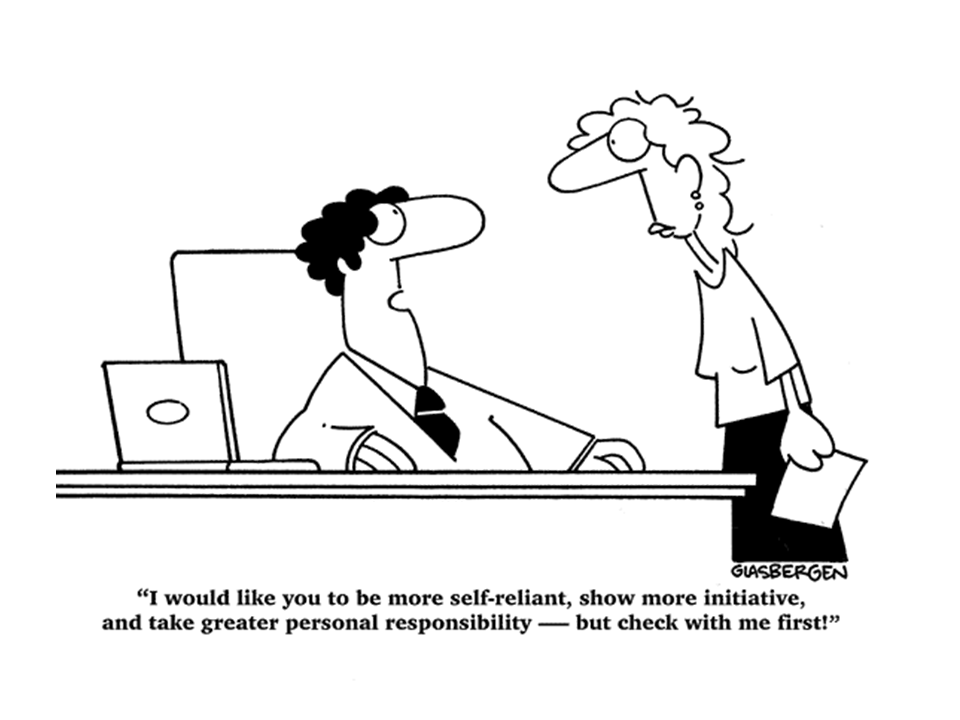
Micro-managing. We've all experienced it. The boss who pays painstaking attention to minutia, resulting in a stifling environment where employees feel their every action is being closely monitored. With few exceptions, a micro-manager's need to control the workplace is a fear-based response to their own insecurity about allowing other people the latitude to make decisions.

We're back to the smartest person in the room syndrome.

Problem is, micro-managed businesses are far more likely to stall, as there is no incentive for initiative; the cornerstone of growth within a healthy organization. On the contrary, micro-managers are risk-averse, reluctant to consider the possibility that anyone else might have a better idea on how to get things done.

It's important to understand what motivates the micro-manager, many of whom are business owners or CEOs. They are motivated by their own fear of failure.

Being The Boss means making major decisions that have a direct impact on the bottom-line. Oftentimes, a manager becomes overwhelmed by the magnitude of top-level decisions, choosing to backburner his actions (a cute euphemism for procrastination). Instead, the boss feels the need to focus his attention on things that will make him feel like he's functioning effectively as a manager. So, by streamlining the supply closet's stapler inventory, the micro-manager feels like he's accomplished something, which helps restore his confidence and the sense that he's in charge.

It's important to emphasize that his positive feeling of accomplishment is the same neurological response (the release of feel-good dopamine into the bloodstream) as his having achieved the more significant, top-level business task. However, the dopamine released is far less significant, resulting in a much shorter-term buzz. The solution? There's more where that came from! As a result, micro-managing, like any feel-good drug-use, usually escalates, making an organization more and more suffocating for the employees.

So, how do you break the cycle of micro-management? It's not easy, particularly if it's part of the corporate culture. It's like that old joke "how many Psychiatrists does it take to change a light bulb? One, but the light bulb has to want to change!"

Unless the micro-manager is given substantial incentive to change, he'll continue to do what feels right. So, what kind of incentives are effective?

· Firm feedback from his manager, who is aware of the problem.

· Indirect employee feedback (staff quit and provide critical feedback upon departure).

· Failing business (this requires a manager with both the insight and fortitude to look at his own performance in direct relation to the results)

· Direct employee feedback (staff who have both the nerve and tact to approach the boss).

The final point is rare, risky, but achievable. Approaching a micro-manager in a non-confrontational manner is an art in itself. Effective methods include:

  • Building the confidence of the manager by keeping him informed of the progress of projects (particularly those that he has shown an interest in).
  • Asking for feedback and direction (even if you have a good idea of what needs to be done), then provide measurable results in a timely fashion.
  • Demonstrating how delegating to you is in his best interest, by voluntarily taking on projects that you know are in your wheelhouse.

It's all about managing upwards.

That said, managing the micro-manager is not easy. As a result, micro-managers lose good employees all the time. So if you find yourself in a position where a micro-manager has eroded your enthusiasm for the job, and you've exhausted all available efforts, it might be time to look elsewhere.

Suggested Reading: MESSAGES: THE COMMUNICATION SKILLS BOOK (Matthew McKay, Martha Davis, Patrick Fanning)

Thursday, May 19, 2011

How I Became A Customer For Life


Like a lot of kids, I developed a love for the game of baseball when I was 10 or 11 years old. In my case, this new interest was undoubtedly sparked by the arrival of the Montreal Expos, who made their major league debut at Jarry Park, in the North end of the city, not far from where I lived.

In retrospect, Jarry Park was not a great ballpark. In fact, it was not the city's first nor second choice for a stadium (The city of Montreal's incompetence regarding stadiums is an entirely different subject for another day!). That said, to an 11 year old kid, Jarry Park was heaven - I used to pay a buck for a seat in the bleachers. It was 2-weeks allowance, but worth every penny!

Now I didn't get to go to a lot of games, but when I did, it was a pretty big deal, and it didn't matter who The Expos were playing. I'd always get there early (really early), to watch warm-ups and batting practice. I never failed to wear my Expos cap, and always brought my baseball glove, dreaming that one day I would snag a foul ball and have the greatest souvenir in the world to show my buddies at school!

The one redeeming quality of Jarry Park, was its intimacy. The park had a capacity of just over 28,000, which is quite small by today's standards (the average MLB park has over 44,000 seats) . But it was never designed for Major League Baseball, and very rarely full. So, I quickly learned that I could buy my $1 ticket and simply walk over to the premium box seats to stand behind the dugout and watch batting practice. Surprisingly often, I discovered that I could stay in an unoccupied box seat for the entire game!

I loved the pre-game warm-ups. As an aspiring ball player, watching the guys toss a ball back and forth, snag pop flies and then hit a few in the cage, was mesmerizing! Anytime one of the players came near the dugout, I tried to overcome my shyness and call them out by name, asking for an autograph on my glove or cap. Occasionally, I even found the nerve to ask for a baseball, if one of the players happened to be bringing a ball back to the dugout!

To me, the players were larger than life.....John Boccabella, Manny Mota, Bill Stoneman, and the guy who actually made it cool to have red hair (and I had a head full of it) - Rusty Staub!

That entire first season, I went to at least a dozen games. Always got there early to watch warm-ups from behind the Expos dugout and always stayed until the final out. Always had my Expos cap & glove, and always asked for autographs from the players during warm-up. But during all those games, not a single player ever stopped to sign my glove or hat. Not one. I figured it must have been me. I started to accept that I just didn't matter to these guys, whom I had come to idolize. I asked less and less.

Then, on a perfect summer day in 1969, I had an experience that changed everything. The St. Louis Cardinals came to town. Although the 1969 Cardinals weren't contenders, they had won the World Series twice in the past 5 years, and had several notable players on their roster - including pitcher Bob Gibson, who still holds the (modern day) major league record for earned run average; Lou Brock, one of the greatest base stealers of all time; and Joe Torre, a great player who would go onto become one of the greatest coaches in the game.

I couldn't tell you exactly what it was that made me walk over to the opposition's dugout that day in June, but there was definitely something about the Redbirds that intrigued me. More importantly, there seemed to be less and less reason to hang out by the Expos dugout. That afternoon, with little effort on my part, Lou Brock signed my cap, Joe Torre autographed my glove, and on his way back from the bullpen, Bob Gibson looked me straight in the eye and tossed a ball right into my mitt!

The Cards won 8-1 that day, but even before the first run was scored, I had become a fan for life. I bought a Cardinals cap as soon as I saved up enough allowance, and wore it faithfully, despite being harassed by kids at school, who couldn't possibly understand why I didn't root for the home town team!

I've been a St. Louis Cardinals fan for more than 40 years now. I've followed the team through some great times and many struggles. But it doesn't matter, Bob Gibson looked me straight in the eye and tossed me a baseball. That's how I became a customer for life!

Saturday, May 14, 2011

I'm Feeling Pretty Good About This Blog

There seems to be an epidemic of unusually high self-esteem.

Now don't get me wrong. When it comes to the taking a stand on the half-full or half-empty analogy, I like to think of the glass as simply being larger than required. I believe that makes me an optimistic leaning pragmatist.
But you can't help but notice that in an increasingly complex world with more than its share of challenges, we seem to feel pretty darn good about ourselves!

Efforts to help build our self-esteem are everywhere. While self-help books, endless classes and courses, framed posters with clever sayings and soul-stirring images, are nothing new, now, more than ever, they seem to propose the solution for whatever ails. Marriage in trouble? Must be your self-esteem. Can't find a job? Got to be your self-image. Can't sink the putt or put away the competition in game 7? Look no further than how you see yourself.
Feeling pretty good about who we are is important, particularly when we deserve it, by doing the right thing whenever possible. Similarly, feeling lousy about ourselves when we do something we know is wrong (and let's face it, we all fail to live up to our own best standards, at times) , is also proper and correct. But the suggestion of many of the self-esteem snake-oil salesmen, is that a robust sense of self will help you to burst through all the uncertainties of life and allow you to carry yourself with nothing but confidence and certainty. Herein lies the problem.

Doubt and caution serve a specific purpose in the way we go about making decisions. And if the uncertain thoughts themselves weren't enough to cause pause and reflection, the accompanying visceral response of our body to stress, is the equivalent of our car's GPS announcing, in that warm but determined voice...."at the first available opportunity, turn around."

We're not supposed to always have the answer. We can't possibly know it all. There's actually no such thing as 'the smartest guy in the room' (and even if there was, the moment we think we are that guy - we're not).

You can certainly understand why we're drawn to this notion of infallibly feeling good about ourselves. The appeal is self-evident.

The problem, however, is that it's behavioral Prozac and dulls the senses. But its par for the course. We're suckers for a quick fix. Feeling lethargic at the mid-point of the afternoon? Have an energy drink. Not happy with lines and wrinkles on your face? Botox them away. Feeling a little uncertain about that presentation you have to give on Monday? You can certainly try a pharmaceutical solution like beta blockers, or, better yet, rehearse to the point where you know the material as well as you can. Know what? You'll still get butterflies in your stomach before stepping out in front of the audience - you're supposed to!

Back when I first performed as a stand-up comic, overcoming severe nervousness before stepping out on stage was a major concern. I'd never felt that level of discomfort before. Someone suggested having a drink before my set, just to take the 'edge' off. I tried it. In fact, I made it a double. It certainly took the edge off. It also threw off my timing, focus and most importantly, my connection with the audience. The same material that had previous audiences laughing, was met with blank stares and polite applause as I left the stage. It was the first and last time I used alcohol to dull my anxiety. Years later, I still get a little nervous moments before beginning any presentation or performance. The day I stop feeling this way, I will really start to worry. That 'edge' serves a purpose!

Like dynamics in music, our feelings are meant to vary and shift. Feeling constantly too high or too low are equally disconcerting. It's all about the balance.


Friday, July 16, 2010

Fire-Prevention in a Fireworks Factory

Curious as to why things are so quiet in his 7-year old son's bedroom, a father walks in to discover that the boy is lighting matches and attempting to ignite one of his toys. Imagine yourself in this man's shoes. You may have experienced something similar in your life, perhaps even from the perspective of the boy.

How would the father typically react? Chances are, unable to control his fear and rage, he yells at the boy to immediately stop what he is doing, adding a few verbal expletives, perhaps physically restraining (or worse) the child in some capacity. This reaction, which can safely be described as a common response, will certainly end the immediate threat, but not likely prevent repetition of the event in the future, and will certainly do little to determine the root cause of the behaviour.

Fear and anger are powerful primordial emotions, which can easily dominate our behaviour. However, they generally trigger short-term solutions, providing, at best, an end to the threat and a venting of our stress. Consideration as to the cause of the threat is generally received on a delayed basis, if at all.

This presents a tremendous conflict for anyone in a position of supervision - whether a parent, manager, or group leader. Because our initial response to wrong behaviour is often that of the parent who has walked in on the child playing with matches. But to truly elevate the awareness and performance of those to whom we are responsible, we must first find a way to break and rewire our own internal default script. Not an easy task after a few thousand years of ingrained behaviour!

The first rule is to fight the urge to solve everything in one fell swoop. In other words, first deal with the immediate threat, then deal with the cause (at an appropriate time). Easy enough to say, but tougher to do in today's increasingly hectic world. This also requires controlling our own initial emotional reaction, which in my case, was once "what the *^% were you thinking?" A response which does little but demean the person to whom it was directed.

Effective behavioural guidance (managing or modifying poor behaviour) requires dealing with the root cause of problem at a time when our response is not fuelled by emotions, but rather a calm environment in which to clearly manage the issue. This process must include a clear articulation of the problem; an effort to understand why it occurred; and a clear communication what is expected, including an explanation of the consequences of future repetition.

Now there is an argument that aversive conditioning* can be a quick and effective method of dealing with negative behaviour. True, if someone receives an electric shock every time they try to take a coin from a jar, they will stop trying. But it doesn't deal with their desire for the coin, nor will it end their attempts to get one elsewhere. There is the old adage that even firemen spend the majority of their time preventing fires, so as to avoid their starting.

However, in times of uncertainty, such as we find ourselves in today, fear inevitably drives the bus and brings in its wake a culture of short-term thinking. But if you can break away from the pack mentality, this is a wonderful opportunity to be extraordinary by thinking longer term and caring enough about the people around you to make the extra effort.

Next time, catching people in the act of doing things right.

*behavior conditioning in which noxious stimuli are associated with undesirable or unwanted behaviour that is to be modified or abolished.

Sunday, July 4, 2010

WE HAVE NOTHING TO FEAR BUT BAD MANAGEMENT ITSELF

There is an often-quoted and misleading notion that fear is a great motivator.

The fact is, fear is a short-term motivator and generally results in low levels of performance. But fear is a base instinct, so it's easy to trigger and the results are predictable. Which is why it continues to be used as a method of managing behaviour within so many organizations.....kind of like managerial fast food - light on nutritional value, but quick and easy. So, many managers continue to attempt to control their subordinates with pearls like "if you can't do it, we'll find someone else who can."

However, after the initial reaction to the threat stimulus, we become acclimatized to the new reality, adjusting our behaviour only as necessary. So, for fear to continue to motivate our behaviour, the threat either needs to escalate, or come at us from a different, unexpected angle.

Which is why behavioural psychologists have always maintained that fear should only be used as a last course of action - not as a primary motivational punch. In other words, when all else fails, be direct with a person - make sure that they understand that they are not performing as required, explain exactly what they need to change (detailing the time frame and measurement method), and clearly state the ramifications of failing to meet the required improvement to their performance.

But the disturbing reality, is that in this economic climate, management by fear has become more the accepted norm. With many organizations so focused on hitting financial targets, the behaviour towards employees has become short-sighted, reverting to archaic tactics - fire a loud weapon into the air, and the herd will, more or less, head in the desired direction.

The result of this management style is inevitable; an organization filled with people whose primary focus is doing the minimum required to maintain job security. There's little initiative, no innovation (management by fear is not conducive to risk-taking), and the best of the bunch are only sticking around long enough until something better comes along. In other words - mediocrity.

Next time, a simple exercise in motivating behaviour through positive reinforcement.

Thursday, June 17, 2010

Failing To Learn From History - How Perspective Is Relative

The Contrast Principle explains how our perception is often relative. As a physical example, if we are standing in the dark and a flashlight is pointed in our face, we will estimate the brightness of the light to be significantly higher than had the room had been well-lit. As a psychological example, if we are conversing with a very attractive person who walks away and an unattractive person approaches and begins a conversation, the second person will seem far less attractive than they actually are.

If you're curious, try this experiment.

Place a bucket of hot water on your left, a bucket of cold water on your right, and a bucket of room temperature water in the middle. Place your left hand into the hot water, and your right hand in the cold water. Now, remove your hands and place both in the room temperature water. The hand that was in the hot water will now feel like it is in cold water, and the hand that was in the cold water bucket will now feel like it is in hot water.

This automatic behaviour is one of many heuristic shortcuts that we apply to the world on a daily basis, and it can be both a benefit and a curse.

If, for instance, your budget for a new car is $35,000, yet you decide to first test drive an $90,000 sports car, the contrast principle will make subsequent test drives feel disappointing and inadequate. On the other hand, if you were to first drive a clunker, subsequent test drives of $35,000 vehicles, will make you feel much better about your budget and eventual car purchase. There are certainly other mitigating factors in being a satisfied car buyer, but all (other) things being equal, the contrast principle can have a profound effect on your perception and therefore your satisfaction.

In other words, there are few, if any absolutes; leaving our perception of the world relative to our experience and expectations. Like many behavioural patterns, this can be powerful 'mojo' to harness, particularly when attempting to persuade the decisions of others. Successful salespeople know this, often intuitively, and (rightly or wrongly) apply the principle in an effort to influence the decisions of customers. And the contrast principle is so powerful, that even when we realize it's being applied to us, it's hard to resist.

Equally, when you have bad news to share, it's not a good idea to diminish the news in hopes of revealing or unleashing a little more over a period of time. Organizations know this when dismissing employees. Rather than spreading the anxious process over a period of days or weeks, efforts are made to have all of the dismissals occur at the same time.

Among the many blunders made by BP subsequent to the Deepwater Explorer explosion in the Gulf Of Mexico, was the attempt to downplay the amount of oil leaking from the damaged well. On April 20, BP claimed that 1,000 barrels of oil (42,000 gallons) was leaking into the Gulf. On May 14, the U.S. government upped the estimate to 5,000 barrels a day. May 27, scientists increased the estimate to between 12,000 and 19,000 barrels a day. June 10, that doubled to 25,000 to 30,000 barrels a day. Yesterday, the new estimate was 60,000 barrels a day - more than 2 and a half million gallons!

Added to BP's many errors of judgment (an understatement), these horrendous 'miscalculations' have augmented, if not cemented public mistrust of virtually any claims made by the company. A taint to its reputation from which BP may never recover.

Could BP have reacted differently? Most certainly.

September 12, 1983, 12-year old Mary Kellerman died after taking extra strength Tylenol. In the next few days, a total of 7 deaths were attributed to tainted Tylenol. The parent company of Tylenol, Johnson & Johnson, acted swiftly and decisively, distributing warnings to hospitals and distributors, and halting Tylenol production and advertising. This was followed by a nation-wide recall of Tylenol - $100 million in product.

The press praised the company for "effectively demonstrating how a major business ought to handle a disaster." A Washington Post article added "This is no Three Mile Island accident in which the company's response did more damage than the original incident."

While Tylenol 's market share initially plummeted from a high of 35% down to 8%, the company's handling of the crisis and subsequent industry-leading security measures (the tainted pills were the result of tampering at the retail level), led Tylenol to become the #1 selling over-the counter analgesic in the U.S.

"Any man can make mistakes, but only an idiot persists in his error."

-Marcus Tullius Cicero

Saturday, June 5, 2010

Don't Rock The 'Upside Down' Boat

In 1961, Genevieve Habert, a Wall Street stockbroker, was walking through the Museum of Modern Art in New York City, when she noticed that Henri Matisse's Le Bateau ("The Boat") was hanging upside down. Habert attempted to report the error to several museum staff, including a guard, whose response was "You don't know what's up and you don't know what's down and neither do we."

Frustrated that no one at the museum would take her seriously, Habert contacted The New York Times, which gained the immediate attention of the museum director. The next day, the work was correctly hung, having been displayed upside down for a total of 47 days.

At the risk of minimizing the current Gulf Of Mexico oil disaster, I can't help but think of the upside down Matisse as a metaphor, as we reach day 47 of this catastrophe.

The more we learn about events leading up to the explosion of the Deepwater Horizon, the more apparent it becomes that multiple opportunities were missed that might well have averted the explosion, loss of human life, and subsequent environmental nightmare. The common thread throughout this series of poor decisions was an emphasis on time and cost-savings, which in the BP world, are synonymous.

And while many media pundits apply the usual black & white filter to the scenario, attempting to identify the BP (& Halliburton & Transocean) disaster as either an accident or the result of pure corporate greed, the truth lies at the much murkier depths of groupthink corporate culture.

When an organization is so focused on achieving its bottom-line that it ignores virtually anything that stands in its way, it's an inevitable recipe for disaster. Groupthink is a powerful behavioural phenomena that makes it tremendously difficult for anyone within the organization to step forward and offer a differing point of view, much less sound an alarm that the proverbial boat may be hung upside down.

Groupthink is evidenced throughout history, from one organizational disaster to another. January 28, 1986, the Space Shuttle Challenger exploded 73 seconds after liftoff. The cause of the problem was an O-ring seal, which failed under cold weather conditions. But NASA engineers were aware of the problem and had warned of the problem - specifically cautioning against launch on January 28, because of the cold weather forecast. But the NASA Flight Director wasn't aware of the engineers concern, because a group of NASA executives, to whom the engineers' report was filed, decided not to act on the warning, as they were collectively frustrated by recent launch delays and emboldened by the overall success of the space shuttle program.

Ultimately, groupthink - a culture of don't rock the boat, if you know what's good for you, is a conditioned state of thinking and can only survive if the individuals within the group remain controlled. And these are powerful controls that take many forms; fear, greed, security, even simple peer pressure.

And while it may seem somewhat counter-intuitive, groupthink can come from either top-down or bottom-up within an organization, as powerful forming forces don't always come from the corner office. Either way, the phenomenon can only occur when allowed to gestate, because groupthink doesn't occur overnight, or the moment an organization is formed. The conditioning required takes time and the right (or perhaps more accurately - wrong) environment in which to flourish.

So when the time comes to postscript the Gulf oil disaster and attest responsibility and consequences, we'll no doubt hear a lot about regulations, oversight (the Minerals Management Service appears to be its own case study in dysfunction), and no end of technical excuses from failed blow-out preventers to methane bubbles, but will anyone address the fundamental issue of dysfunctional corporate culture?